Fashion Laws for and Against Copyrifht
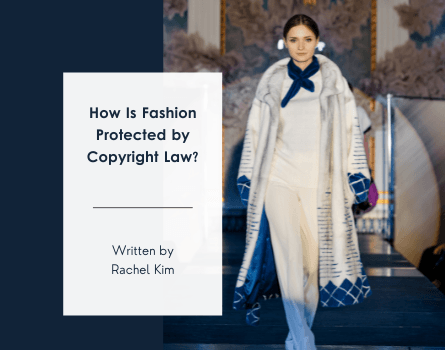
This week, yous may have seen photographs and videos of long runways where models donned the season's latest trends and styles. It's Fashion Week 2022– the fourth dimension of twelvemonth when designers finally get to testify off months of hard piece of work through their craftmanship of various habiliment and accessories.
What you don't run across during Way Calendar week is the laborious procedure of designers conceptualizing new creations, sketching them out, and capturing them in the fabrics and materials of the clothing they craft. Merely are these fashion designers rewarded for all their hard work and inventiveness by copyright—more to the point, are their manner designs protected by copyright constabulary? The short respond is that it depends.
Copyrightability in Style
According to the Merriam-Webster Dictionary, way is defined as "the prevailing manner of a detail time." In the way manufacture, trends and designs change from season to season in the form of diverse elements, which usually manifests itself in a variety of colors, silhouettes, types of fabrics, unique cuts of fabric, and prints.
When determining whether and how manner is protected past copyright law, information technology's important to empathise the scope of copyright protection for fashion items. The Copyright Act does non protect ideas, concepts, or facts. If the color of chartreuse, polka dots, or a elementary balloon sleeve is the latest trend, copyright law protections practise non extend to those blueprint elements alone. In fact, the Copyright Office Compendium notes that the Copyright Office more often than not refuses to annals "[c]ommon patterns, such equally standard chevron, polka dot, checkerboard, or houndstooth designs, "geometric figures and shapes," "alphabetic or numbering characters," or simple arrangements of such unprotectable elements.
For instance, the Copyright Office rejected Bus'due south registration application for a fabric design containing "a pattern consist[ing] of 2 linked 'C's' facing each other alternate with two unlinked 'C'southward' facing in the aforementioned direction." A New York federal district court held in Coach, Inc. v. Peters, that the Copyright Office exercised its proper judgement in rejecting Coach's awarding since the Copyright Office reasoned that under copyright law, mere letters of the alphabet and the arrangements of that letter ,"C," were non sufficiently creative or original enough and so that the design was protectable nether copyright law.
Manner As a "Useful Commodity"
The Copyright Human activity also does not extend protection to useful manufactures, which is defined as "an commodity that has an intrinsic utilitarian part that is non just to portray the advent of the commodity or to convey information." There was a time in the not-too-afar past when the Copyright Function mostly refused to register claims to copyright in clothing or costume designs on the "basis[s] that articles of wearable and costumes are useful articles that ordinarily incorporate no creative authorship separable from their overall utilitarian shape."
Merely the Office changed its policy in 1991 when it released a Policy Conclusion about its examining practices with respect to "fanciful costumes." Specifically, the Function noted that it would register these works "if they contain separable pictorial or sculptural authorship. The separable authorship may be physically separable, meaning that the piece of work of art can be physically removed from the costume, or conceptually separable, meaning that the pictorial or sculptural work is independently recognizable and capable of existence apart from the overall commonsensical shape of the useful commodity."
But in 2016, the U.S. Supreme Court abandoned the physical separability test in the case, Star Athletica v. Varsity Brands. The Court set out a standard for determining copyrightability in way designs and for useful articles in general in a case most the copyrightability of cheerleader unforms. According to the Court, while copyright law may non protect the general notion of "style" information technology does protect design elements which:
- "can be perceived as two- or three-dimensional works of fine art split from the" fashion item itself; and
- "qualify as a protectable pictorial, graphic, or sculptural piece of work, either on its own or fixed in some other tangible medium."
This is the standard the Copyright Office and courts must employ when evaluating copyrightability in useful articles similar clothing and style accessories (including jewelry).
So What Fashion Designs Are Protectable Under Copyright Law?
By way of analogy, hither are some design elements where mode may exist protectable under copyright law:
- Graphic Designs: Copyright law would protect the designs on the surface of fashion items only as it protects designs on the surface of a canvas or sheet of paper. For such protections to use, copyright law only requires that the designs on the surface of fashion items (like the designs contained on the surface of any other medium) demonstrate a very minimal corporeality of creativity. The U.S. Supreme Court besides addressed this issue in Star Athletica v. Varsity Brands, stating that "2-dimensional designs appearing on the surface of [clothing]" including "combinations, positionings, and arrangements" of shapes, colors, lines, etc. are protectable past copyright."
- Cloth Designs: Similarly, a producer of fabrics tin can rely on copyright to protect "designs imprinted in or on textile—if the design contains a sufficient amount of creative expression." In fact, the case Unicolors v. H&One thousand, which is currently pending in the U.Southward. Supreme Court on registration issues, concerns an infringement of intricate geometric patterns that were designed by the design-making company Unicolors.
- Logos: Copyright law tin can protect logos. Simply the key is that logos must accept sufficient creativity and originality nether copyright police. The Copyright Role has refused to register copyrights in logos when the logos were accounted have but contained common letters, typography, and geometric shapes without whatsoever elaborate or intricate arrangements that would amount to sufficient creativity under copyright constabulary. For instance, the Copyright Office has refused to register various logos of famous brands including Adidas's "3 Confined" logo and Tommy Hilfiger's "Flag" logo. However, designers can still by and large observe protections for their brands' logos under trademark police force.
And and so there are some design elements that copyright law would not protect. For those design elements, it's important to remember that other types of intellectual belongings laws, including trademark and patent constabulary, may provide protections for designers.
- Color: Copyright protection does not extend to colors. If a designer wants to protect a signature color or a unique color scheme, copyright is not the avenue. Merely that doesn't mean there are no options for protection of the designer's intellectual belongings. Trademark protection may be available in these instances.
- Cutting: The way that pattern elements are cut and pieced together is non protected by copyright. The U.S. Supreme Court recently addressed this topic in the Star Athletica case, stating that copyright affords "no right to prohibit any person from manufacturing [clothing] of identical shape, cut, and dimensions." But, over again, that doesn't hateful there aren't other kinds of protections that embrace cuts. Pattern patents may afford protections for this type of design element. (And different copyright, a design patent can prevent others from creating fashions that resemble a sketch of the original design.)
Whatsoever the trend, designers work hard to stay competitive and on height of the spirit of the times by laboring on their collections in time for Mode Week 2022. Information technology's clear that the creativity and originality in a designer's expression is what copyright police was meant to protect.
If you aren't already a fellow member of the Copyright Brotherhood, you tin bring together today by completing our Private Creator Members membership form! Members gain access to monthly newsletters, educational webinars, and so much more — all for gratuitous!
0 Response to "Fashion Laws for and Against Copyrifht"
Post a Comment